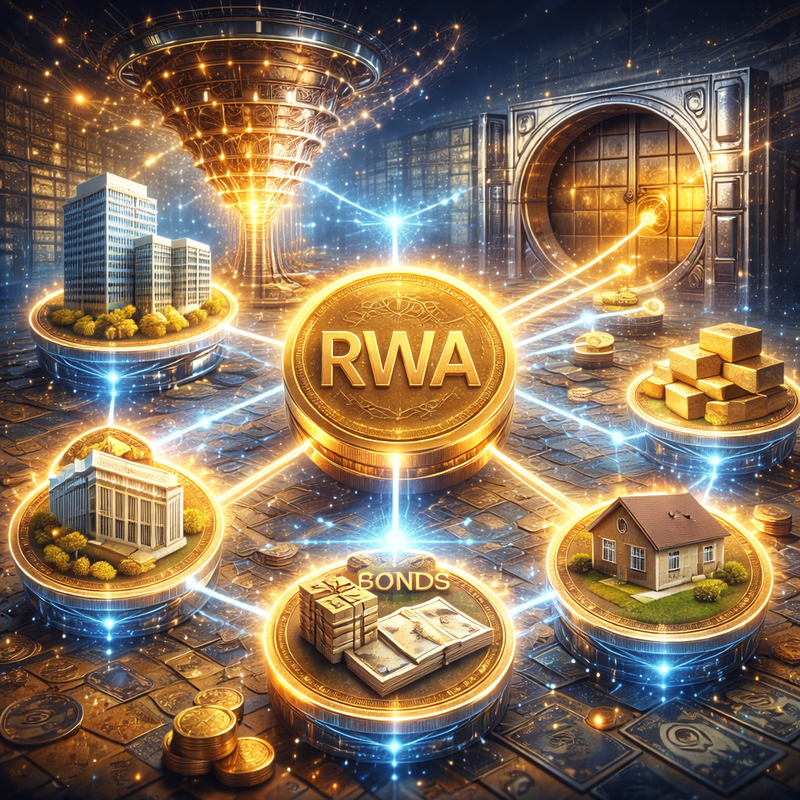
 ▲ Real World Asset (RWA) Tokenization / Image generated by ChatGPT |
While the broader cryptocurrency market is experiencing a sharp price correction and growing pessimism, the tokenization market linked to real-world assets has entered an independent growth trajectory, reaching all-time highs backed by strong support from institutional investors.
According to Cointelegraph on Feb. 16 (local time), the real-world asset (RWA) tokenization market is emerging as a new core driver of the industry, recording steady capital inflows even amid a steep downturn in major assets including Bitcoin (BTC). On-chain data analysis shows that the total value locked in real-world asset tokens has recently surpassed $17.1 billion, marking a new record high. This serves as a decisive indicator that capital is shifting away from highly volatile traditional cryptocurrencies toward yield-generating financial products backed by tangible assets.
Sergey Nazarov, co-founder of Chainlink, analyzed that the current downturn differs significantly from previous cycles. “This recent market slump paradoxically demonstrates how far our industry has progressed,” Nazarov said, emphasizing that “real-world asset tokenization has moved beyond a mere experiment and has established itself as a standard within the mainstream financial system.” He added that the market’s very structure is changing as major asset managers such as BlackRock operate tokenized funds worth $2.2 billion and begin directly participating in the DeFi ecosystem.
Yuval Rooz, co-founder and CEO of Digital Asset, also described the current market situation as a cleansing process in which so-called hollow tokens with no intrinsic value are being eliminated. “The recent sell-off is prompting a reassessment of token models without substance and pushing institutions to migrate toward chains that offer value, transparency, and predictability,” Rooz stated. As a result, traditional financial institutions are increasingly focusing on on-chain financial services backed by real-world assets such as government bonds, private equity, and real estate rather than speculative assets.
Concrete business expansions are also drawing attention. Brazil’s Mercado Bitcoin has issued a $20 million tokenized private fund through the Bitcoin sidechain Rootstock, with plans to expand it to $100 million by April. In the Solana (SOL) ecosystem, a backstop facility has been launched that enables institutions to redeem real-world assets instantly into stablecoins, beginning to resolve liquidity bottlenecks. Japan’s SBI Holdings has also entered the competitive landscape by launching “Strium,” a dedicated blockchain for institutional foreign exchange and real-world asset transactions, in partnership with Startale.
Experts project that the real-world asset tokenization market could grow to as much as $30 trillion by 2030. Analysts suggest that even if just 1–2% of the $450 trillion global asset market migrates to blockchain, it would generate growth that surpasses the entire cryptocurrency market. As regulatory compliance improves and technological gaps are addressed, real-world asset tokenization is expected to serve both as a buffer against crypto market downturns and as a key gateway for the full-scale adoption of blockchain by the traditional financial sector.
Disclaimer: This article is for investment reference only and the publisher is not responsible for any investment losses incurred based on this content. The information provided should be interpreted for informational purposes only.