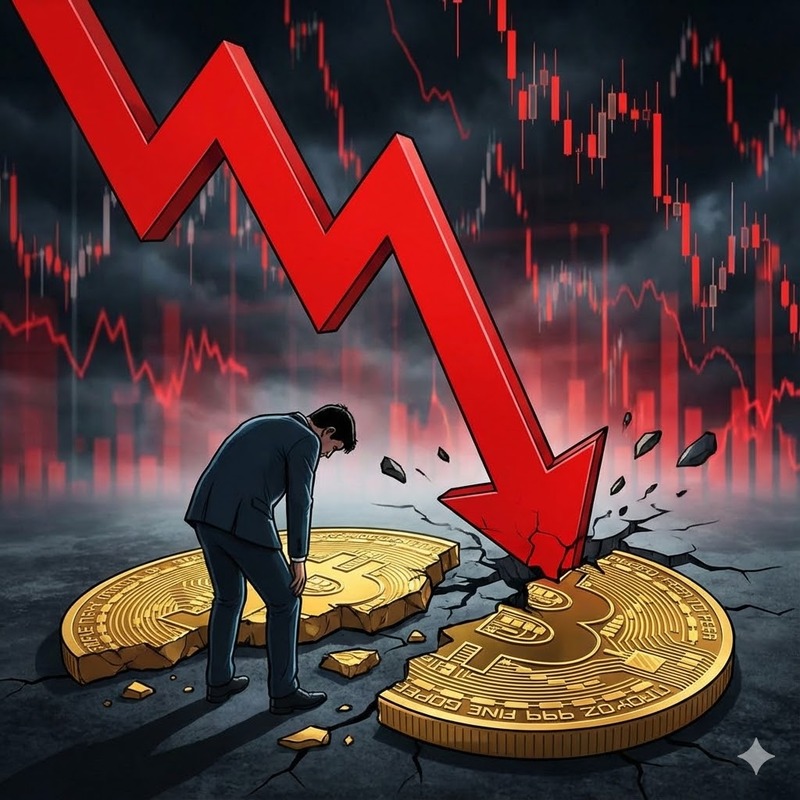
 ▲ Bitcoin (BTC), Investor, Crash/AI-generated image © |
[Analysis] Fears of Full-Scale War in the Middle East Over the Weekend… Bitcoin Faces Its Real Test at the ‘Monday Opening’
Geopolitical tensions in the Middle East have reached their highest level in decades following a preemptive strike on Iran by the United States and Israel and Iran’s subsequent retaliatory attacks. Bitcoin, the leading cryptocurrency that trades 24/7, absorbed the brunt of war fears over the weekend in place of traditional financial markets, falling to the $63,000 level. As global financial markets are engulfed in extreme uncertainty, we examine the short- and mid-term outlook for Bitcoin.
■ Short-Term Outlook: Bitcoin as the Weekend ‘Pressure Valve’… The Real Crisis Comes Monday
In the short term, Bitcoin acted as a kind of “pressure valve” for geopolitical risk while traditional financial markets were closed. During the weekend, when stock, bond, and foreign exchange markets were shut, it was the only channel through which institutional and retail investors could quickly offload risk assets and secure liquidity. As a result, long positions worth hundreds of millions of dollars were liquidated in a chain reaction, maximizing market volatility.
The true inflection point for short-term direction is expected to come on Monday (Monday–Tuesday Korea time), when global traditional financial markets, including equities and commodities, reopen simultaneously. If global stock markets open with gap-down declines and portfolio managers pursue large-scale deleveraging across asset classes, Bitcoin could face a second wave of heavy selling. Should this secondary shock materialize, the $60,000 level— the last line of defense during the early February crash— is likely to come under strong threat.
■ Mid-Term Outlook: Surging Oil Prices and ‘Sticky’ Inflation Concerns… Limits of a High-Beta Risk Asset
From a mid-term perspective, the fate of the crypto market depends on whether this conflict escalates beyond a localized clash into a prolonged, full-scale war across the Middle East. If the war expands and energy infrastructure in the Gulf region is hit, driving international oil prices sharply higher, it would directly reignite global inflation.
If inflationary pressures intensify again, major central banks, including the U.S. Federal Reserve, would lose room to cut interest rates. Prolonged high interest rates would drain market liquidity, exerting severe mid-term downside pressure on Bitcoin, which is highly sensitive to liquidity conditions.
In past geopolitical crises in the Middle East (such as in 2020 and April 2025), Bitcoin showed resilience by rebounding after an initial sharp drop as traditional markets digested the news. However, this situation differs in that it involves a potential full-scale war encompassing major oil-producing nations, making a swift rebound difficult to guarantee. In particular, as Bitcoin has increasingly behaved not as a “digital gold” safe-haven asset but as a high-beta risk asset moving in tandem with traditional equities during times of crisis, the likelihood of a prolonged, range-bound corrective phase near the lower end of its trading band remains high until the situation stabilizes.
*Disclaimer: This article is for investment reference only and the publisher is not responsible for any investment losses incurred based on the information provided. The content should be interpreted solely for informational purposes.*