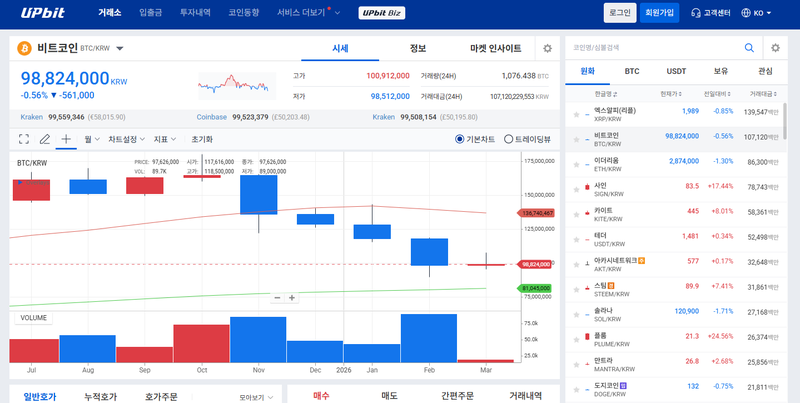
 ▲ Upbit Market Conditions as of 7:01 a.m. on March 9 |
As geopolitical risks stemming from the Middle East escalate again following the selection of Iran’s new Supreme Leader, flagship cryptocurrency Bitcoin (BTC) has fallen below the 99 million won level, fully exposing the frozen investor sentiment.
As of 7:01 a.m. on March 9, according to Upbit, South Korea’s largest cryptocurrency exchange, Bitcoin was trading at 98,824,000 won, down 0.56% from the previous day, slipping beneath the 99 million won mark. Although it briefly recovered to 100 million won the previous day in an attempt to rebound, it failed to withstand mounting macroeconomic headwinds and fell back again.
Major altcoins also turned lower across the board. XRP (Ripple), one of the top cryptocurrencies by market capitalization, fell 0.85% to 1,989 won, breaking below the 2,000 won level. Ethereum (ETH) declined 1.30% to 2,874,000 won, while Solana (SOL) dropped 1.71% to 120,900 won, continuing their weak performance.
The key factor behind the renewed downturn in the digital asset market is the rising war tension in the Middle East. Iran’s Assembly of Experts recently appointed Mojtaba Khamenei, the son of the late Supreme Leader who was killed in U.S. and Israeli airstrikes, as the new Supreme Leader, pushing market fear to extreme levels. Concerns are spreading that the emergence of a hardline figure with strong influence within Iran’s Islamic Revolutionary Guard Corps (IRGC) could lead to an expansion of military conflict, including a full-scale war with Israel.
Heightened geopolitical tensions have immediately fueled a surge in international oil prices and revived inflation concerns, further intensifying widespread fears of stagflation. As risk-off sentiment reaches extreme levels, global capital is accelerating its exit from the cryptocurrency market in a broad deleveraging trend, seeking refuge in traditional safe-haven assets such as the U.S. dollar and gold.
Going forward, the digital asset market is expected to exhibit heightened volatility depending on the new Iranian leadership’s initial foreign policy moves and military actions. For the time being, macroeconomic and geopolitical developments are likely to dominate the market entirely, outweighing individual fundamentals or positive news. Experts advise prioritizing conservative risk management—closely monitoring developments in the Middle East and increasing cash reserves—rather than attempting to predict the bottom through aggressive dip-buying.
Disclaimer: This article is provided for investment reference purposes only and we are not responsible for any investment losses arising from its use. The content should be interpreted for informational purposes only.