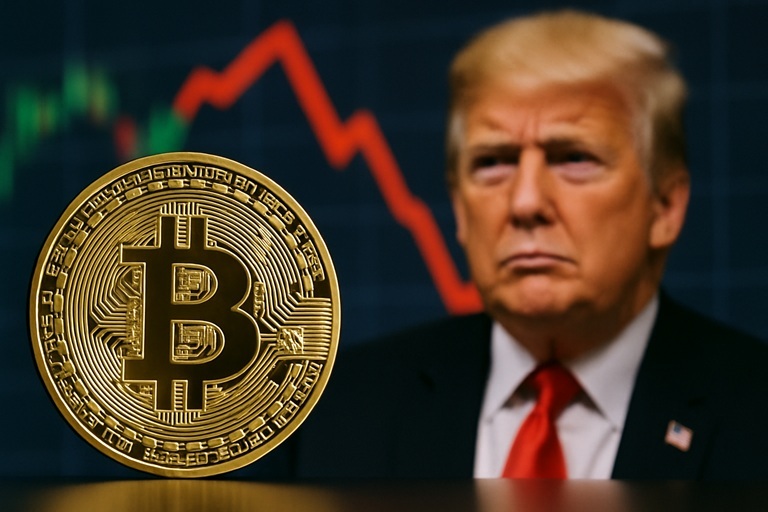
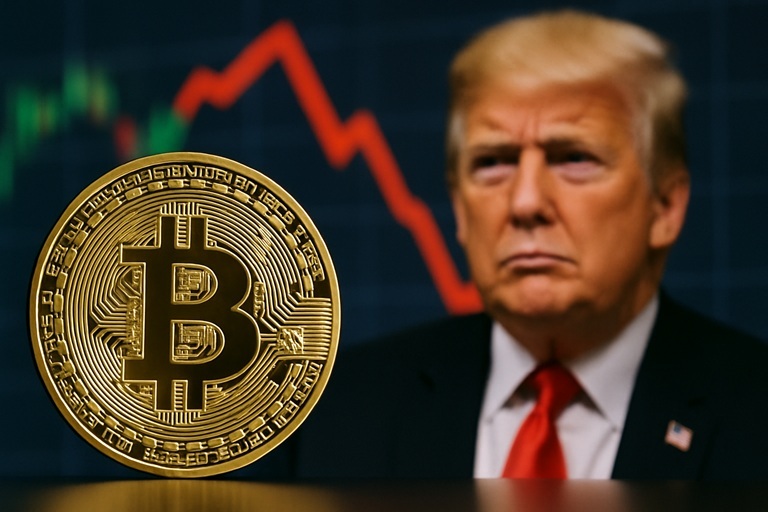
 ▲ Bitcoin (BTC), Donald Trump/ChatGPT-generated image © |
Bitcoin has surrendered all of its gains since President Trump’s election victory and has even fallen below the $70,000 level. An analysis suggests that the current downturn stemmed from forced liquidations in derivatives positions by institutional investors. Looking ahead, some 전망 indicate that the current correction could become a strong buying opportunity as macroeconomic paradigm shifts align with the United States’ pro-Bitcoin stance.
Baek Hoon-jong, CEO of SmashFi, appeared on Channel A News’ YouTube program “Economic Signal” on the 15th to provide an in-depth assessment of the recent decline in Bitcoin and its future outlook.
Baek explained that the recent sharp decline was not due to negative factors intrinsic to Bitcoin but rather liquidity issues faced by hedge funds. “Bitcoin has now established itself as a major financial asset, leading hedge funds to bundle it together with gold, silver, and stocks in their investment portfolios,” he said. “These funds employ cross-margin strategies across multiple assets, and following the nomination of Kevin Warsh as Federal Reserve Chair, gold and silver prices plunged. As a result, massive sell-offs occurred in the Bitcoin market—the only market open over the weekend—to secure margin requirements,” he analyzed.
As for the potential bottom in case of further declines, he suggested the $55,000 level. “On-chain data shows that the average purchase price of currently active Bitcoin (based on realized market capitalization) stands at around $55,000,” Baek stated. “In previous bear markets, this overall average price level served as a strong bottom, making it reasonable to view this range as the most logical support level at present.”
However, he emphasized that the long-term outlook remains very bright. He identified Kevin Warsh, the nominee for next Federal Reserve Chair, as the most significant positive factor. “Warsh has demonstrated a high level of understanding of Bitcoin, even describing it as a ‘market police’ that warns against the Federal Reserve’s misguided monetary policies,” Baek said. “Once he takes office and the ‘shadow regulations’ constraining the traditional banking sector are lifted, banks could potentially introduce high-yield special deposit products backed by Bitcoin in connection with companies like MicroStrategy (MSTR).”
He also noted that the global economy’s transition toward a “wartime economy” system enhances Bitcoin’s strategic value. “As the United States pours enormous power resources into securing leadership in AI and semiconductors, the Bitcoin mining industry—capable of flexibly utilizing surplus electricity in remote areas—will become an essential strategic asset when integrated with AI data centers,” Baek projected. He added that rumors of the Trump administration “sweeping up Bitcoin if it falls below $60,000” may not be mere conspiracy theories but could reflect a national-level strategy.
In contrast, he offered a somewhat gloomy outlook for altcoins. “U.S. cryptocurrency legislation, including the Clarity Act, is being structured primarily around traditional banks, making it difficult for altcoins lacking strong independent narratives to benefit from policy support,” he warned.
Finally, regarding investment strategy, Baek advised, “Bitcoin is the safest form of hard money capable of replacing fiat currencies that continuously lose value. Rather than trying to time the market, investors should thoroughly study Bitcoin’s value, gain conviction, and hold it long term with the same belief shown by early Tesla investors.”
Disclaimer: This article is for investment reference only, and we are not responsible for any investment losses incurred based on it. The content should be interpreted solely for informational purposes.